BLOG
What Is Heavy Machining? The Role of Heavy Machining in Industrial Equipment Manufacturing & Repair
- 27 Mar 2026
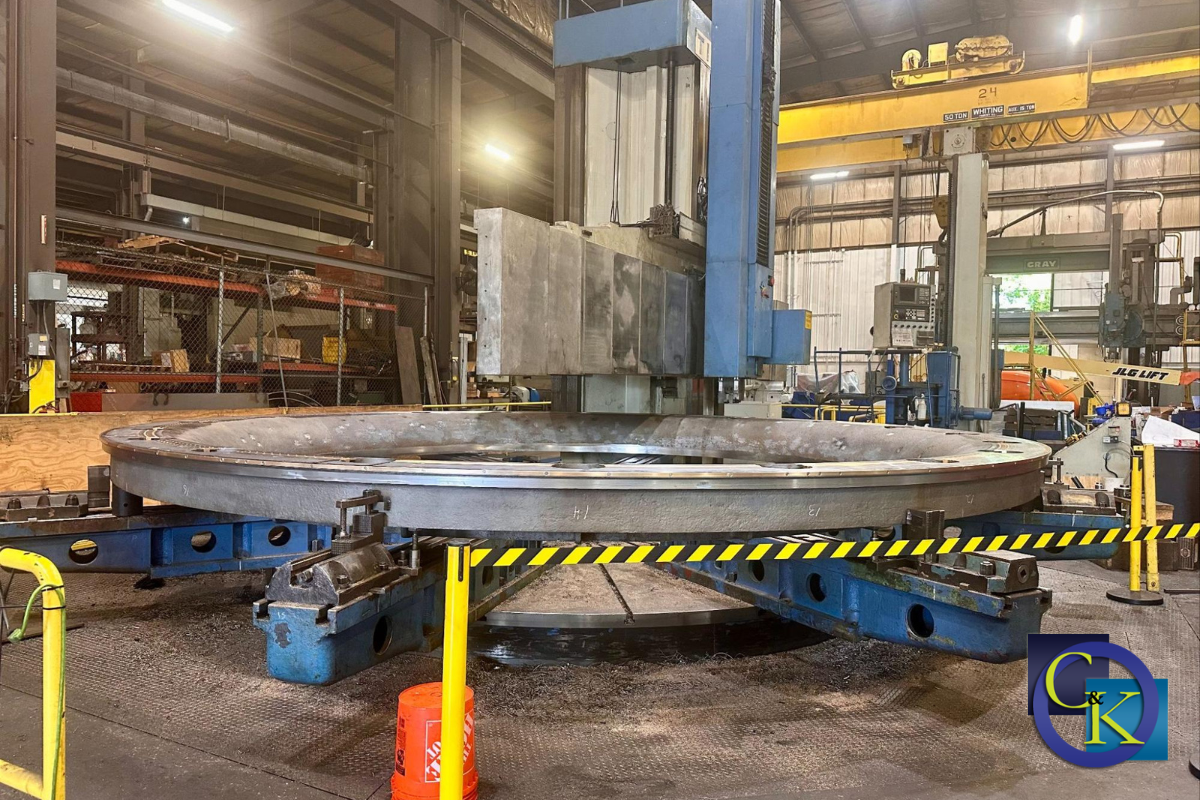
Short answer: Heavy Machining, sometimes referred to as large part machining, is a subtractive manufacturing process where stock material, typically metal, is removed from a component that exceeds the size and/or weight thresholds of standard machine tools. These components, often made from steel, stainless steel, or specialty alloys, weigh upwards of 5 Tons (10,000 lbs.) at the low end of the weight range and can easily weigh more than 10 Tons (20,000 lbs.). The items being machined are commonly bar stock, heavy plate, castings, forgings, or fabrications. The operational “envelope” of the machine tools required for specific machining operations will often determine whether the machining process is considered “Heavy Machining.” While there are no set dimensions, the following examples serve as a good guide for the sizes of parts that would fall within the Heavy Machining designation:
Engine Lathe: chuck diameter of 36” and/or 16’ length between centers
Vertical Boring Mill (VBM) or Vertical Lathe: table diameter of 12’ and/or vertical height of 10’ or more under horizontal rail
Horizontal Boring Mill: rotary table 8’ on a side and/or travel length of 20’ and/or total machining height of 8’
Heavy machining requires large-scale machine shop capabilities. This includes robust machining equipment with extended reach, high horsepower, overhead lifting systems, reinforced foundations, adequate lay down space, and skilled operators who understand how to rig, setup, and machine large / heavy parts.
Why Heavy Machining Matters
Heavy machining plays a critical role in manufacturing and maintaining the equipment used in industries such as power generation, chemical refining, oil and gas, steel production, and industrial manufacturing. These sectors rely on equipment, such as turbines, pumps, compressors, valves, and gear systems, that must hold precise tolerances to operate reliably. When these large components need repair, modification, or refinement, heavy machining provides the controlled, repeatable precision required to return them to service.
The Types of Work Involved in Heavy Machining
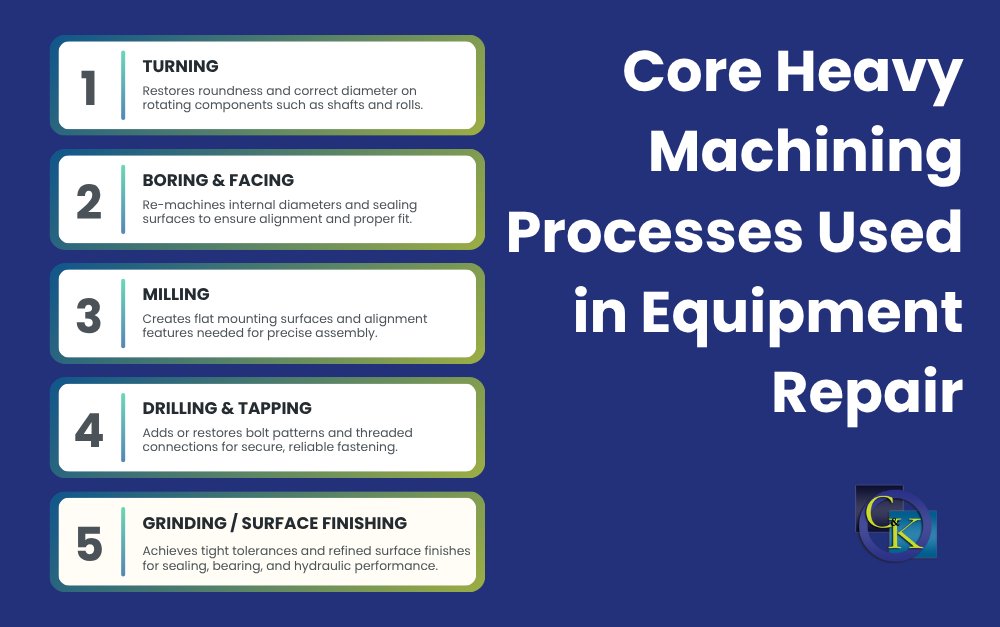
Heavy machining involves a range of precision machining processes used to repair, rebuild, or manufacture large-scale industrial components. The goal is to establish or restore critical dimensions, surface finishes, and alignment features that allow equipment to operate reliably under load. Common machining tasks include:
- Turning to restore roundness on bearing housings, bearing journals, rolls, shafts, and seal diameters
- Boring and facing to correct internal diameters and sealing surfaces
- Milling mounting faces, slots, and structural interfaces
- Drilling and tapping fastener patterns for assembly
- Grinding to achieve a tight surface finish and tolerance requirements
These processes must be executed with control and repeatability, especially when working on components where there are tolerance stacking concerns over a distance or with components that weigh many tons.
Precision and CNC Control at Large Scale
Heavy machining often relies on Computer Numerically Controlled (CNC) machines to achieve consistency across complex geometries or long travel distances. CNC controls allow the machinist to maintain maximum precision over the full length or diameter of a part. When possible, machining is performed in a single setup, meaning the component stays fixed in place while all required surfaces are machined. This reduces alignment variation and ensures that features relate accurately to one another, which is critical for rotating and sealing components.
Engineering, Fabrication, and Repair Integration
Heavy machining frequently works alongside:
- Fabrication and welding
- Stress relief and heat treatment
- In-house engineering and reverse engineering
- Dimensional inspection and quality verification
This integrated repair approach allows damaged or worn components to be built back to specification, rather than simply replaced. In many cases, material can be added through welding or plating and then machined or ground to the final dimension. When non-load bearing surfaces require dimensional restoration (e.g. housing bore, bearing journal or sealing diameter), possibly with a wear resistant coating, thermal spray may be used without the heat input (and distortion) associated with welding processes. As many of the thermal spray coatings can be quite hard (mid 60s HRC on the Rockwell scale), they are typically ground post application to achieve the required surface finish. These varied manufacturing and repair techniques support equipment throughout their lifecycle and help extend asset life while minimizing downtime and replacement cost.
Material Considerations and Machining Requirements
The choice of material directly influences the machining approach. Components made from steel, stainless steel, hardened alloys, or corrosion-resistant materials require specific cutting tools, speeds, and cooling strategies to avoid distortion or premature tool wear. The machinist must understand how each alloy responds under cutting pressure, heat, and load to ensure the final component meets both dimensional and structural requirements.
Why Heavy Machining Matters in Industrial Equipment Repair and Overhaul
Industrial equipment operates under constant stress, high temperatures, heavy loads, continuous vibration, and corrosive or abrasive process conditions. Over time, these forces lead to wear, misalignment, surface degradation, and dimensional loss in critical components. Heavy machining plays a direct role in restoring these parts to a reliable operating condition and protecting the equipment’s overall performance.
Common Equipment Failure Modes that Heavy Machining Addresses
Heavy machining is frequently used to repair and extend the life of:
- Turbines and rotors: to correct shaft journals, seal surfaces, and balance conditions
- Pumps and compressors: to restore split line housing flatness and parallelism, housing and bore concentricity, column fits, shaft diameters, bearing journals, mounting surfaces
- Gear systems and reducers: to machine bores, mounting faces, and gear interfaces
- Actuators and valves: to refurbish sealing surfaces and mechanical linkages
- Rolls, drums, and drive shafts: to remove scoring, deformation, or wear patterns
In each case, the goal is to interrupt the failure cycle and return the component to a state of stable, repeatable, dependable operation.
Supporting Preventive Maintenance and Long-Term Asset Performance
Heavy machining is not only used during failures or emergency repairs. It is also important for preventive maintenance and asset lifecycle planning. By restoring surfaces and alignment before damage escalates, maintenance teams can:
- Reduce unplanned downtime
- Improve efficiency and throughput
- Minimize the cost of major rebuilds or replacements
- Extend the operational life of critical equipment
When combined with root-cause analysis, for example, identifying misalignment, lubrication deficiencies, or thermal stress, machining becomes part of a long-term reliability improvement strategy.
When Field Machining Is Required
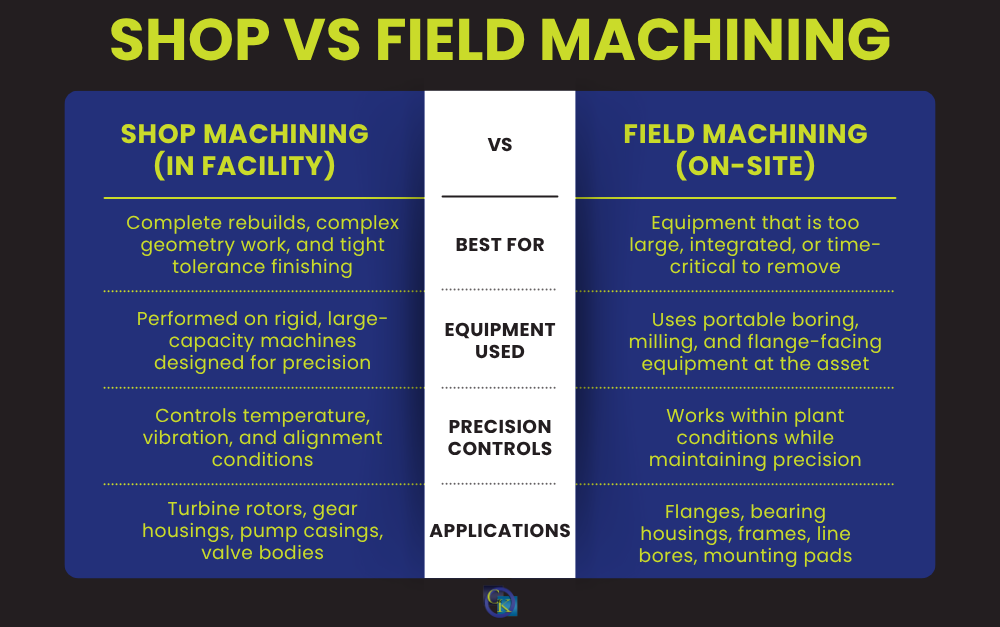
In many industrial environments, the size, configuration, or operational importance of certain equipment makes it impractical to remove components and transport them to a machine shop. Turbines, pump assemblies, gear housings, pressure vessels, and structural frameworks are often built into place, connected to piping systems, electrical controls, or foundation-mounted bases. In these situations, field machining brings the machining capability directly to the equipment, allowing repairs to happen on-site, without full disassembly.
Portable Machining Performed Directly at the Facility
Field machining relies on portable, heavy-duty machining systems that can be mounted to the equipment itself. These tools are designed to achieve precision tolerances under less controlled conditions. Typical field machining services include:
- In-place boring to restore bearing or housing diameters
- Portable milling to machine flat surfaces, mounting pads, or structural joints
- Flange facing to ensure smooth, accurate sealing surfaces on piping and vessel flanges
- Line boring to correct the alignment of bores across long distances
- On-site drilling and tapping for fastener patterns or structural attachments
- Precision measurement and alignment to verify centerlines, parallelism, and fit
Field machining is supported by laser alignment and precision measurement systems, ensuring that machined surfaces return to proper centerlines, sealing geometries, and mechanical relationships. Each service is designed to restore the function and alignment of critical surfaces without removing the equipment from the facility.
Reducing Downtime and Avoiding Unnecessary Disassembly
Field machining is often the most efficient option in environments such as:
- Refineries and petrochemical plants
- Power stations and utility operations
- Steel mills and rolling facilities
- High-volume manufacturing plants
In these operations, every hour of downtime affects production, output, and cost. Field machining allows maintenance and rebuild work to be completed during planned outages or short operational pauses. By avoiding the need to disconnect piping systems, lift major assemblies, or transport components to an external shop, organizations save both time and risk while maintaining reliability.
Planning, Measurement, and Technical Coordination Are Essential
Successful field machining requires careful preparation. Because the work must meet the same precision standards as shop machining, planning involves:
- Accurate measurement and inspection of existing conditions
- Engineering review to determine machining approach and required tolerances
- Setup of fixturing or mounting systems on the equipment itself
- Verification of alignment before and after machining
- Consistent documentation to support future maintenance records
This combination of logistical coordination, technical expertise, and process oversight ensures that on-site machining delivers results equivalent to controlled shop machining.
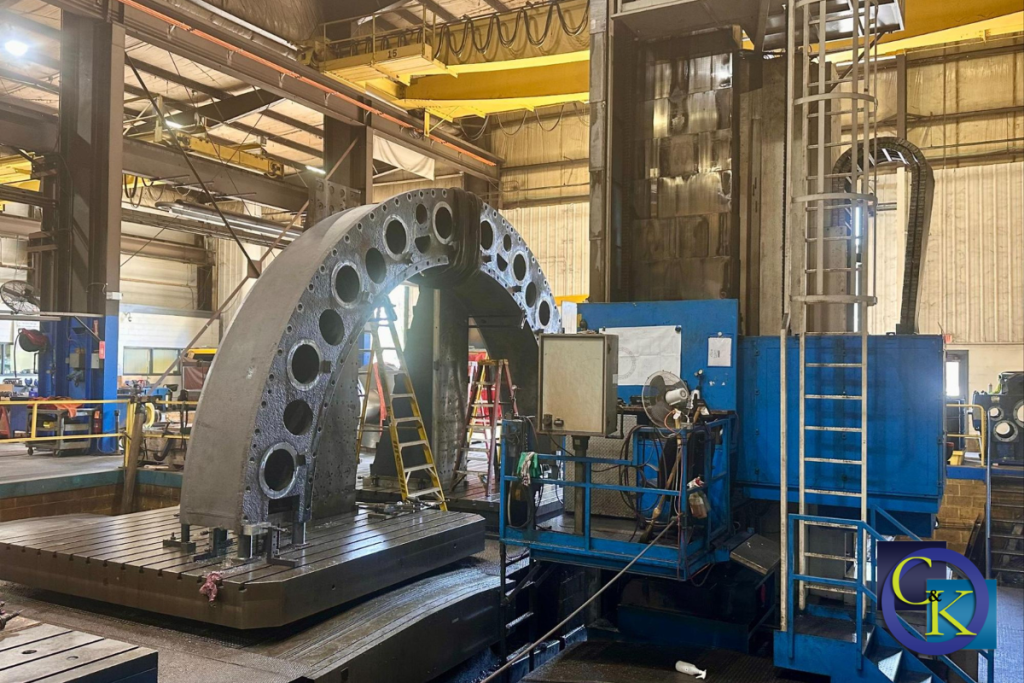
How Chalmers & Kubeck Supports Heavy Machining and Industrial Equipment Reliability
Heavy machining is most effective when it is supported by both the right equipment and the right expertise. Chalmers & Kubeck has one of the largest independent full-service machine shops in the United States, with facilities equipped to handle large-scale Welding & Fabrication, Conventional Machining, OD/ID Grinding, Gear Grinding, Precision CNC Turning and Milling, Thermal Spray Coatings, and complex heavy component repair and overhauls. Our machining centers, cranes, foundation systems, and shop layout are designed specifically to support the capacity requirements of industrial equipment up to 50 tons.
The C&K teams work extensively with combustion / hydro / nuclear power generation equipment, aluminum and steel production assets, aggregate and cement mills, refinery and petrochemical companies, and well known Original Equipment Manufacturers. For these industries, the performance and reliability of their equipment is non-negotiable. Our heavy machining capabilities enable us to manufacture and refurbish engineered pump housings and components, large fabrications, gearing systems, hydro power turbine equipment, blowers and fans, valve bodies, and industrial drive components to precise specifications.
Our engineers, machinists, and repair technicians work together to identify root-cause issues, develop the correct machining and repair plan, and verify results against clear quality standards. This approach helps prevent repeat failures, reduce long-term maintenance costs, and improve equipment uptime. Contact us today to learn more!