BLOG
What Makes a Quality Gearbox Repair?
- 27 Mar 2026
A quality gearbox repair comes down to a few things: accurate diagnostics, skilled technicians, the right replacement parts, and a repair facility with the machining capabilities to handle the job correctly. When an industrial gearbox goes down, you need more than a quick fix. You need a team that can identify the root cause of the failure and restore the gear unit to its original operating specifications.
Below, we’ll walk through what separates a reliable gearbox repair from one that leads to repeat failures and even more costly downtime.
The Silent Warning Signs Most Operators Miss
Most gearbox failures don’t happen overnight. They build up over weeks or months, and the early signs are easy to overlook. An unusual noise coming from the gear unit is easy to miss if the reliability engineer isn’t routinely walking down the equipment or doesn’t have the time to do so. A subtle vibration increase or a small rise in operating temperature can signal that something is wearing down inside the housing, but if those things aren’t being monitored, who knows? Or if there is data, but no established process control limits, a subtle but definitive change over a long period of time may be normalized and missed. Engineers who solely rely on vibration data may even fall into the trap that “everything looks normal” without additional data from oil analysis and/or a physical inspection. Vibration data looks good but there is a huge pile of metal shaving in the oil sump? Yep, it happens more often than you think.
Catching these issues early makes the difference between a manageable repair and a complete overhaul. This is why predictive maintenance tools like routine borescope inspections are so valuable. A trained technician with the right inspection tools can spot internal damage, bearing wear, and gear tooth deterioration before they turn into catastrophic failures. They help you plan your maintenance budget and outages – they give you time to react – time to order that spare gear drive, time to have spare gearing manufactured, or time to order those custom manufactured long lead bearings. Most importantly, they help you avoid forced outages and valuable lost production time.
How the Gear Repair Process Actually Works
Not all gearbox repair services follow the same process, and that matters more than most people realize. A quality industrial gearbox repair follows a structured, repeatable approach that leaves nothing to guesswork. It’s not just changing the bearings and seals and hoping for the best.
Disassembly and Inspection
The gearbox is carefully taken apart, and every component is cleaned, measured, and inspected. This includes but is not limited to coupling fits (worn?), keyways (cracks?), housing bores, bearing journals, seal diameters, and gear teeth condition (visual and dye penetrant testing). Bearing and seal conditions are assessed before replacement. When a bore or diameter is measured, the measuring equipment is accuracy verified against calibrated standards – three measurements are taken per feature both to get an accurate size and to verify that the feature is indeed round. Critical applications might require a housing base and bore inspections using a laser tracker, magnetic particle inspection of the gearing, gear tooth inspection for profile and lead, and/or verification of electrical run outs for proximity probes.Technicians document the condition of each part and look for the root cause of the failure, not just the symptoms.
Root Cause Analysis
This step is critical. If a bearing or gear fails, a quality repair shop will ask why it failed. Was it a lubrication issue? Misalignment? Overloading? Material or Manufacturing Issue? Maybe there was a process change and the gear drive service factor isn’t adequate for the new application? Without identifying and addressing the root cause, the same failure will happen again. Experienced professional service technicians with decades of experience know where to look and what questions to ask.
Repair and Machining
Depending on what the inspection reveals, the repair might be somewhat simple or rather extensive. If there was damage to the housing (e.g. bearing spun), the repair may involve sleeving the damaged bearing bore or machining the gear box split line and line boring the entire housing and skim cutting the baseplate. If a gear set needs replacing, the preferred method is to do that in pairs (gear and pinion) and that is a requirement when a bevel set is involved. A potential alternative to replacing a gear set may involve grinding the bull gear to remove pitting and manufacturing an oversize pinion to match the geometry.
A well-equipped machine shop with precision CNC Machining capability can manufacture replacement parts to OEM specifications when OEM parts are not available. This is especially important for older gear systems and equipment where spare parts may no longer be stocked by the original manufacturer. If a replacement gear set is manufactured, there are various material and heat treatment options available, including carburization, to help increase the longevity of the replacement gearing.
A standard repair always includes replacing all the bearings and seals and typically requires repair to damaged sealing surfaces on the input and output shafting. These sealing surfaces can be repaired and upgraded with hard stainless steel using High Velocity Oxy Fuel (HVOF) applied Thermal Spray. If the environment is particularly abrasive (e.g. Cement Mill), a Plasma applied ceramic Thermal Spray coating would be virtually resistant to wear – they are diamond ground to a smooth surface finish. If the input or output shaft faces downward, upgrading the standard lip seal to a mechanical seal may be prudent if the oil level is not monitored or if there are environmental consequences should an oil leak develop at the seal area – this upgrade usually requires machining of the housing.
If there are issues with oil longevity or performance under load, an auxiliary lubrication system with filtration and/or cooling may be the proper solution. The filtration units can be equipped with redundant filters so one of the filters can be “hot swapped” without shutting down the gearing unit. An oil analysis program will help identify issues before they become major problems.
Reassembly and Testing
The gearbox is reassembled to the highest standards, with all clearances and tolerances verified. Everything is thoroughly cleaned including the lubrication system. Bearing end float, backlash, and contact patterns are all checked. Before it ships back to you, the unit is no-load spin tested to ensure it is leak free, the bearing temperatures are acceptable, and that there are no unexpected noises or vibrations. The gear teeth are protected with an anti-corrosion lubricant and the housing internals are protected using a desiccant breather.
Why Your Repair Facility Matters More Than You Think
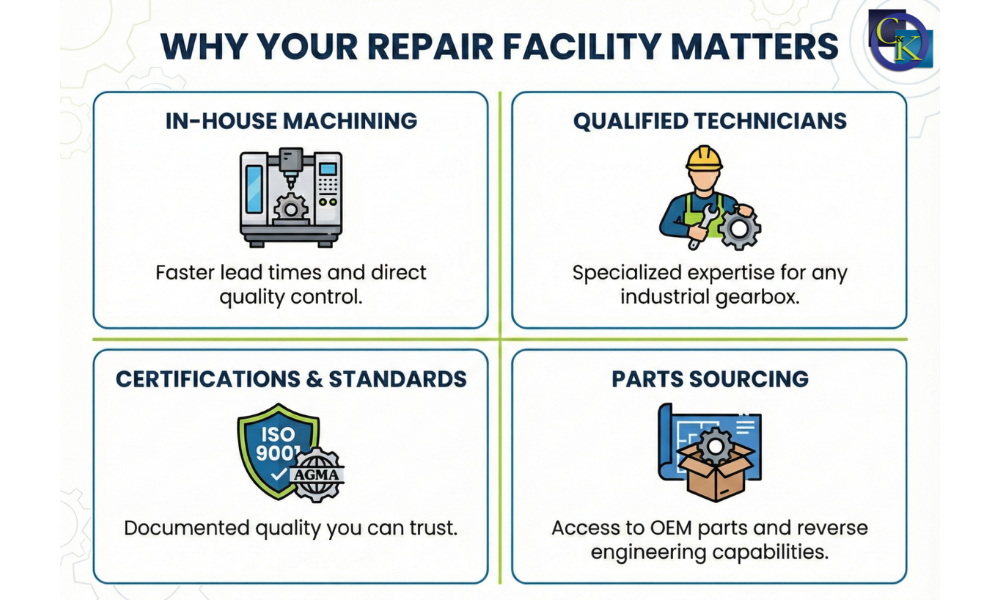
The shop doing your gearbox repair needs more than good intentions. It needs the right equipment, certifications, and people. Here’s what to look for when choosing a repair facility for industrial gear repair services.
In-House Machining
A full-service repair facility with its own machine shop can manufacture gears, shafts, and other components on-site. This cuts down lead time significantly and gives the repair team direct control over quality. If a shop has to outsource its machining, you’re adding time, cost, and an extra layer of risk.
Qualified Technicians
Look for skilled technicians who specialize in industrial gearbox repair. Experience with a wide range of gear types and brands matters. A team that has worked on everything from Marley gear reducer units to large industrial drive systems will be better prepared to handle whatever they find inside your gearbox.
Certifications and Standards
Quality certifications like ISO 9001 and membership in organizations like the American Gear Manufacturers Association (AGMA) indicate that a shop takes quality seriously. These aren’t just plaques on the wall. They represent documented processes, quality controls, and accountability. If the gear repair shop has relationships with other OEMs (e.g. Service Partner or Authorized Service Center) you can be assured you’ll get a quality overhaul to best support your operations team.
Parts Sourcing
A reliable repair partner should have access to OEM parts and the ability to reverse-engineer and manufacture components when original parts aren’t available. The availability of spare parts and replacement parts directly affects your turnaround time.
The Real Cost of Cutting Corners on Gearbox Repair
Choosing the cheapest gearbox repair option is tempting, especially when downtime is adding up. But a low repair cost upfront often leads to much higher costs down the road. Poorly executed repairs result in repeat failures, extended downtime, and potential damage to connected equipment in the power transmission system.
Consider this: a gearbox that fails in service can damage other components in the drivetrain, turning what should have been a routine repair into a full system overhaul. In critical applications like power generation or chemical processing, an unexpected gearbox failure can shut down an entire operation. The cost of lost production will almost always dwarf the cost difference between a quality repair and a bargain one.
A thorough gearbox refurbishment done right the first time protects your investment and keeps your operation running. It is also worth factoring in the value of a maintenance plan. Regular maintenance, including periodic inspections and oil analysis, extend the life of your gear unit and helps you plan repairs on your schedule rather than reacting to emergencies.
When to Repair vs. When to Replace
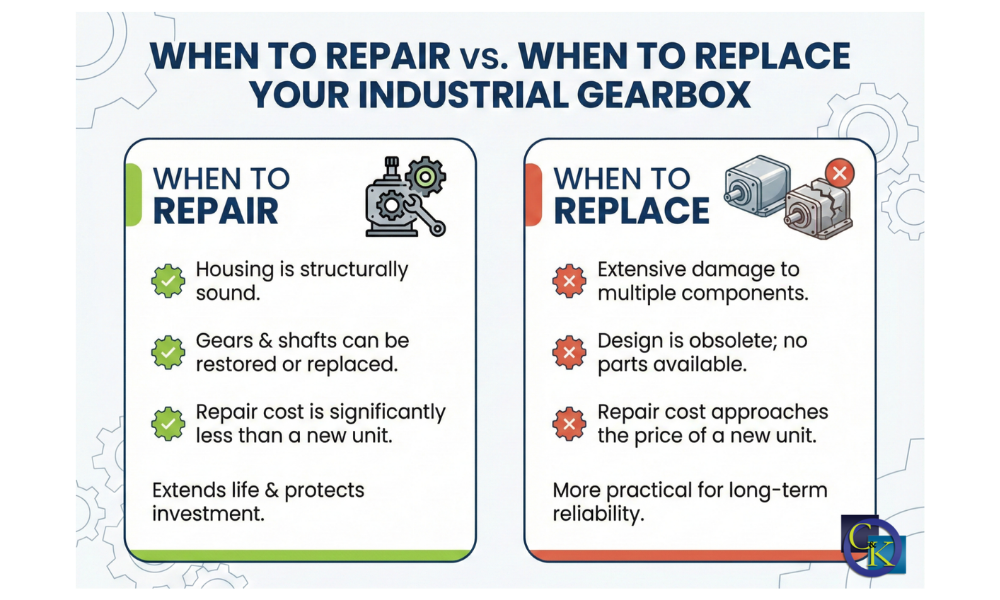
Not every gearbox can or should be repaired. In some cases, the damage is extensive enough that a new gearbox is the more practical and cost-effective option. A trustworthy repair shop will give you an honest assessment rather than pushing unnecessary work.
Generally, repair makes sense when the housing is structurally sound, gears can be restored or replaced, and the cost of repair is significantly less than a new unit with a comparable lifespan. Replacement may be the better path when there is extensive damage to multiple components, the gearbox design is obsolete with no available replacement parts, or the cost of repair approaches the price of a new gearbox.
A quality repair partner will walk you through the options and help you make the right call based on your specific situation, budget, and operational needs. If your repair partner has OEM relationships, they should be able to help you select and source a replacement gear box for your application. Don’t be surprised if they start asking you lots of questions about your process – they want to ensure they are providing you a product that will meet your needs. If they don’t ask questions, be concerned – these are engineered products, not cookie cutter solutions. While there are rarely a “drop in replacement” solutions, a quality service partner can design and provide the necessary adaptations to make the replacement process go as smoothly as possible.
How Chalmers & Kubeck Delivers Industrial Gearbox Repair You Can Count On
At Chalmers & Kubeck, gearbox repair is one of the things we do best. Founded in 1950 and headquartered in Aston, Pennsylvania, we’ve built our reputation over decades of experience serving power generation, manufacturing, oil and gas, chemical processing, and other heavy industries across the U.S.
Our Gear Division operates out of a 150,000-square-foot repair facility equipped with 130 machine tools and up to 50-ton crane capacity. We handle everything in-house, from gear manufacturing and shaft repair to bearing replacement and full gearbox overhauls. As an AGMA member since 1989 and an Official FLENDER Service Partner, we bring both the technical knowledge and the hands-on capability to deliver results.
What sets us apart is our commitment to finding the root cause of every failure, not just fixing what’s broken. Our borescope inspection services help clients catch problems early, and our 24-hour emergency gear repair response means we’re ready when you need us most. We also support pump repair, valve and actuator service, and a full range of machining and maintenance capabilities.
If you’re dealing with a gearbox issue or want to set up a preventive maintenance plan for your gear systems, contact our team to discuss how we can help minimize downtime and keep your equipment running at peak performance.