BLOG
Subtractive vs Additive Manufacturing: What’s the Difference?
- 27 Mar 2026
Short Answer: Manufacturing has come a long way since the industrial revolution, but two fundamental approaches still define how parts get made. Subtractive manufacturing removes material from a solid block to achieve a desired shape. Additive manufacturing, on the other hand, builds parts layer by layer from a raw material. Both are valuable, but each serves a different purpose depending on the part, the material, and the tolerances involved.
Understanding the difference between these two approaches isn’t just academic. Choosing the wrong manufacturing process can mean wasted time, wasted material, and a final product that doesn’t hold up when it matters most. Below, we’ll break down how each method works, where each one shines, and how to decide which is right for your application.
Cutting Away to Build: How the Subtractive Manufacturing Process Works
The subtractive manufacturing process starts with more material than you need and removes what you don’t. A cutting tool carves, drills, or grinds away excess material from a solid block until what remains matches the design. Think of it like a sculptor working a block of stone, except the chisel is a precision-guided spindle, and the stone is a billet of steel or aluminum.
The most common subtractive manufacturing methods include CNC milling, turning, drilling, and electrical discharge machining (EDM). These subtractive manufacturing techniques all rely on computer-aided design (CAD) files and numerical control systems to guide every movement of the cutting tool with repeatable accuracy. A modern CNC machine can hold tolerances measured in thousandths of an inch, which is why the subtractive process remains the traditional method of choice for producing metal parts that demand high precision and an excellent surface finish.
Common subtractive techniques like waterjet cutting and laser cutting also fall under this umbrella. Each subtractive method is suited to different materials and geometries, but they all share the same core principle: start solid, remove what isn’t needed.
Building Layer by Layer: How the Additive Manufacturing Process Works
Where the subtractive process removes, the additive process builds. The additive manufacturing process creates parts by depositing or fusing material one thin layer at a time, guided by a digital computer-aided design model. It’s essentially 3D printing technology scaled for industrial use.
Several types of additive manufacturing technology exist, each with its own strengths. Selective laser sintering (SLS) uses a selective laser to fuse powdered material into solid layers. Binder jetting bonds powder with a liquid agent. Vat photopolymerization cures liquid resin with light. Fused deposition modeling (FDM) extrudes heated thermoplastic through a nozzle. Each additive manufacturing method and additive technology opens up possibilities that traditional manufacturing methods simply can’t match.
The real strength of additive machines is their ability to produce intricate designs, intricate geometries, and complex shapes that would be extremely difficult or impossible to machine from a solid block. Internal channels, lattice structures, and organic forms are all within reach of this printing technology. That makes the additive manufacturing method especially valuable for rapid prototyping and early-stage product development.
Head-to-Head: Key Differences Between Additive vs Subtractive Manufacturing
When comparing additive vs subtractive approaches, the differences go beyond just “add” or “remove.” Each manufacturing method brings distinct advantages depending on the application.
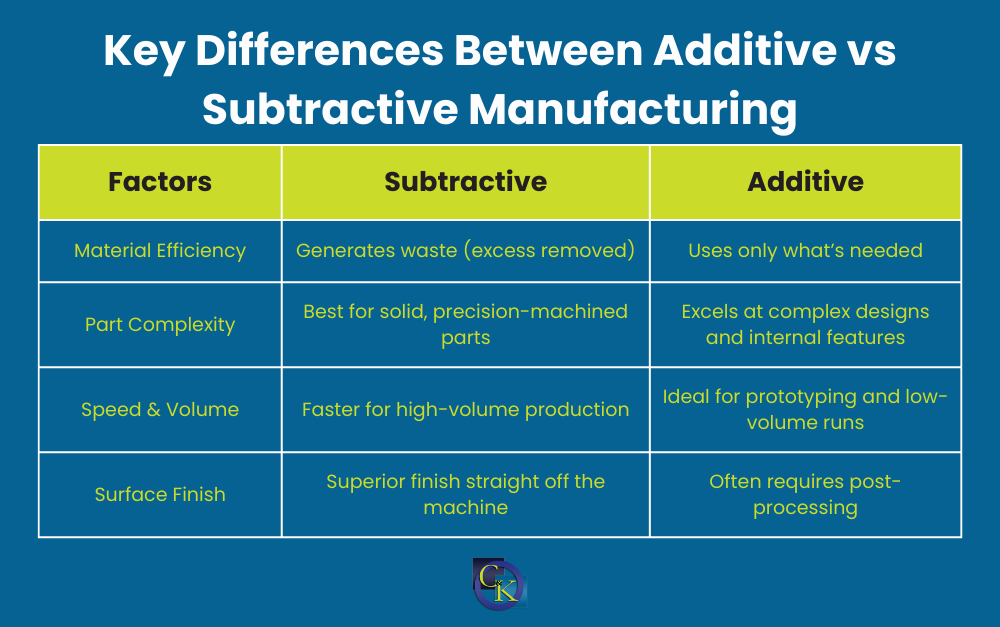
Material efficiency is one of the most cited differences. The subtractive process generates chips, shavings, and excess material that must be recycled or discarded. The additive process deposits only the material that ends up in the finished product. For expensive alloys, that difference adds up fast.
When it comes to complex parts and complex designs, additive manufacturing has a clear edge. But for high-volume runs requiring tight tolerances on metal parts, subtractive manufacturing is still hard to beat. The surface finish on a CNC-machined part is typically ready to go. Additive parts often need grinding, polishing, or additional machining before the finished product meets spec.
Choosing the Right Approach: When to Use Each Manufacturing Process
Subtractive manufacturing is the go-to when you need high precision, repeatable tolerances, and proven material performance, especially for critical industrial components like turbine parts, valve seats, and pump shafts. If the part has to perform under extreme pressure, temperature, or stress, a CNC machine working from a solid block of high-grade alloy is still the most dependable path to a reliable final product.
Additive manufacturing is the better choice for rapid prototyping, producing parts with intricate geometries, or creating one-off complex parts where material efficiency is a priority. It’s also increasingly used in product development workflows where speed to first part matters more than production volume.
It’s worth noting that hybrid manufacturing, combining both additive and subtractive methods on a single part, is gaining traction. A part might be printed to near-net shape using an additive process, then finish-machined on a CNC to achieve final tolerances and surface finish. This approach captures the material efficiency of additive with the precision of subtractive.
When Tolerances Can’t Be Compromised: Why Precision Machining Still Matters
Additive manufacturing technology is advancing fast, and it’s opening doors that didn’t exist a decade ago. But in industries like power generation, chemical processing, and oil and gas, the margin for error is razor-thin. When a turbine component, valve internal, or pump shaft has to perform under thousands of PSI and extreme temperatures, the manufacturing process behind that part matters just as much as the design itself.
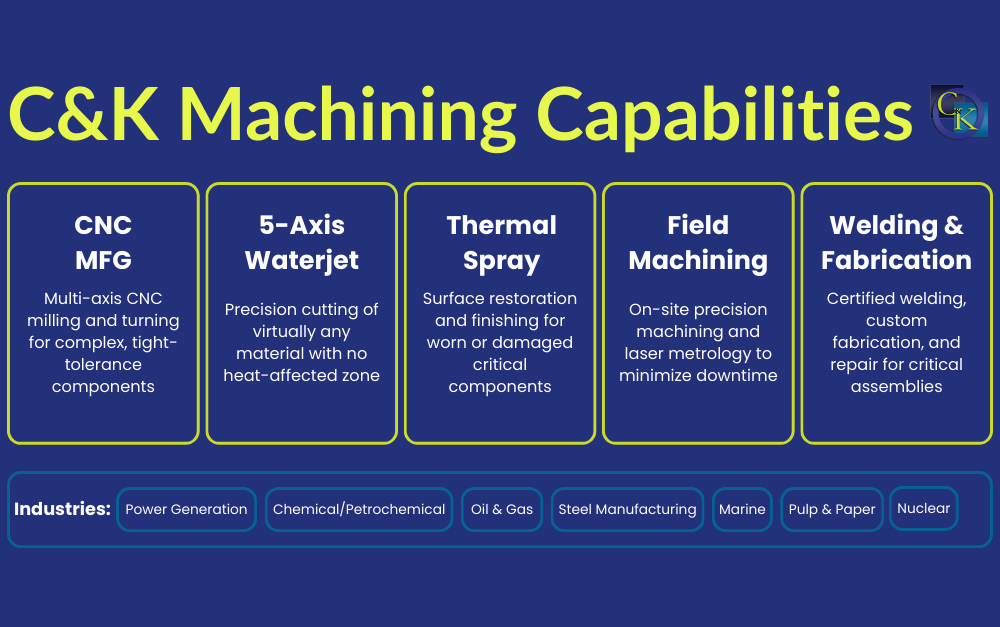
That’s where C&K (Chalmers & Kubeck) comes in. With decades of experience and advanced CNC machine capacity across multiple facilities, C&K delivers the high precision machining that critical equipment demands. From custom-engineered metal parts to emergency repairs on components that can’t wait, our team has the technical depth and the shop floor capability to get it done right. Our machining and maintenance services cover everything from precision turning and milling to thermal spray and grinding for critical wear surfaces.
As an independent industrial service provider with factory-authorized credentials, C&K supports the full lifecycle of your equipment, from precision manufacturing to field machining services and everything in between. When your operation depends on parts built to perform under pressure, we’re the partner you can count on.
Ready to Talk About Your Next Project?
Both subtractive manufacturing and additive manufacturing have a place in modern product development. The right choice depends on the part, the material, the tolerance, and the stakes. When your application calls for precision-machined components built to hold up in the most demanding environments, C&K has the experience, equipment, and technical know-how to deliver. Contact us today to discuss your next machining or manufacturing project.